
Days. Hours. Minutes, seconds. That is how time moves, isn’t it, when you are caring for a loved one with dementia? Dementia becomes the big PAUSE on your life, the interrupter, the disruptor of rhythm. And what to do when you feel you can’t even breathe anymore? Well, you do just that: Breathe. Not from your lungs but from your belly—the diaphragm. Soft belly.
Though my mother transitioned nearly two and a half years ago, dementia still touches my life, if not directly. Two of my dearest friends are coping with loved ones who have dementia and are helping them through their journey. They both talk of experiences I’ve already gone through. Whatever the diagnosis, whether it’s dementia due to Alzheimer’s or some other underlying condition, the thru lines are where we all meet along the way, those of us who are caregiving or partnering in care. There is talk of how a loved one’s walking is off or has stopped completely; or how swallowing has become difficult, or how sleep patterns are askew or eating patterns have changed. There is incontinence and confusion, bladder infections, and so on. We walk alone with our experiences but are connected by the similarities within them. This is why dementia caregivers support groups are so helpful: Whatever the cause, many symptoms and problems overlap, essentially, I’d say, even if oversimplifying, because there are only four lobes of the brain dementia can deteriorate, and most forms of dementia overlap because of which lobes are affected and the functions they have for the body. So, group members understand each other and what they are going through. It’s that connection to others who really get it that is so valuable.
I’ve been thinking about this for quite a while and decided it was time for me to review the brain, look at its lobes, and review how the different lobes are impacted by the most common forms of dementia due to Alzheimer’s, Lewy Body, Vascular causes, or Frontotemporal degeneration.
Here are two images of the brain’s four main lobes, excluding the insula, or insular cortex, which some consider the fifth lobe that separates the temporal lobe from the parietal and frontal lobes. I mention it because, according to Cleveland Clinic, it plays a critical role in various functions, including emotion processing, self-awareness, and sensory integration.
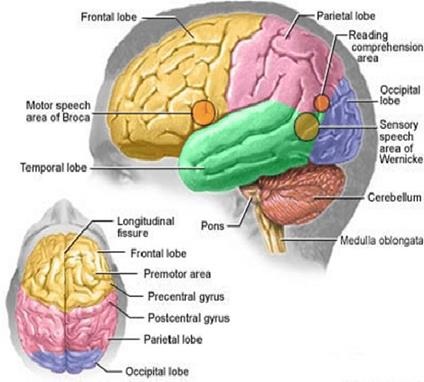
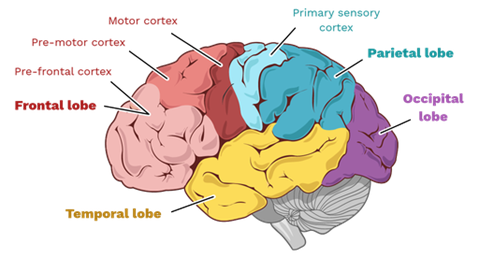
I wanted to know what the functions were for each lobe of the brain and which areas of the brain are impacted by the top four dementia conditions. Here’s what I found:
FRONTAL LOBE: The frontal lobe is affected by Alzheimer’s, Frontotemporal Degeneration (FTD), Lewy Body, Stroke and Transient Ischemic Attack (TIA).
PARIETAL LOBE: The parietal lobe is affected by Alzheimer’s, Lewy Body, Stroke and TIA.
TEMPORAL LOBE: The temporal lobe is affected by Alzheimer’s, Lewy Body, FTD and TIA.
OCCIPITAL LOBE: The occipital lobe is affected by uncommon types of Alzheimer’s such as Posterior Cortical Atrophy, Lewy Body and Stroke.
(Cleveland Clinic)
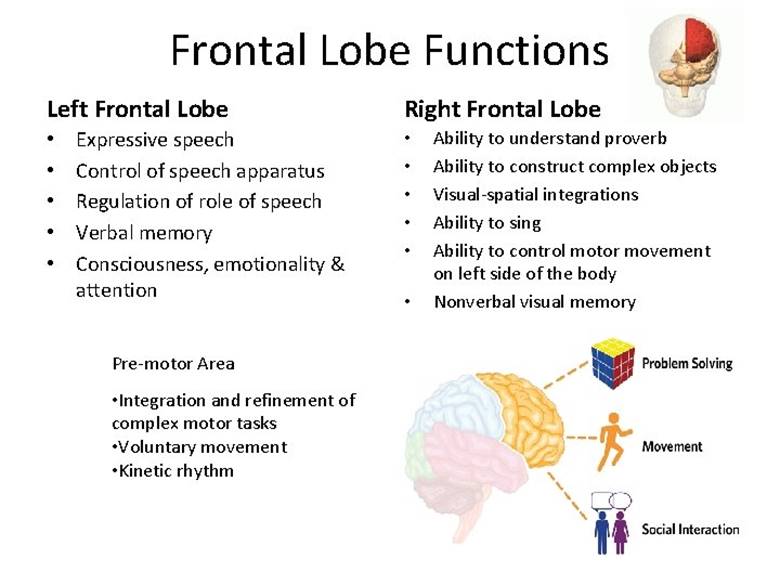
(File credit: SlideToDoc)
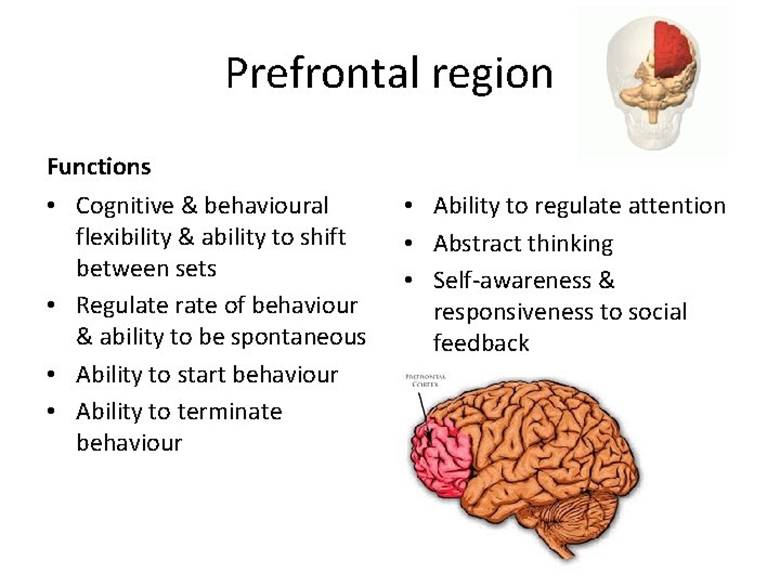
(File credit: SlideToDoc)
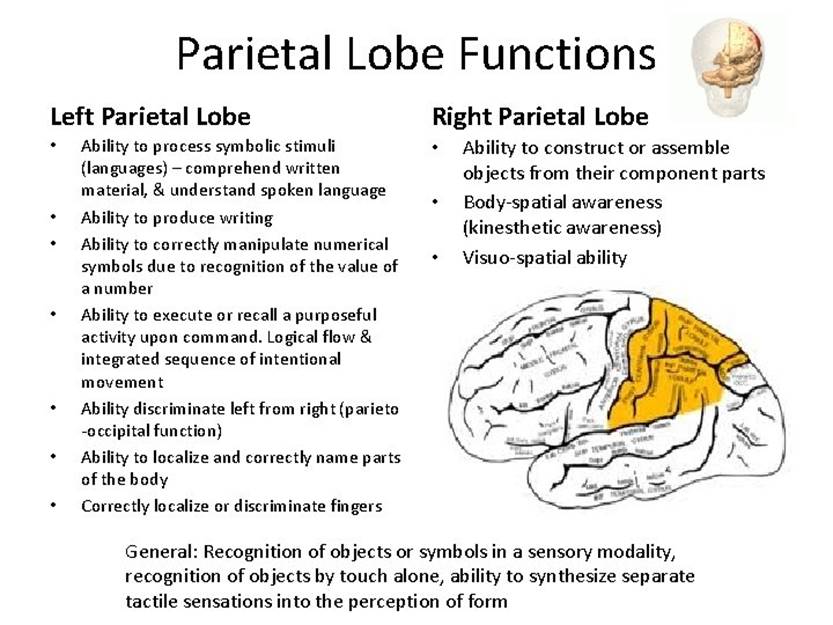
(File credit: SlideToDoc)
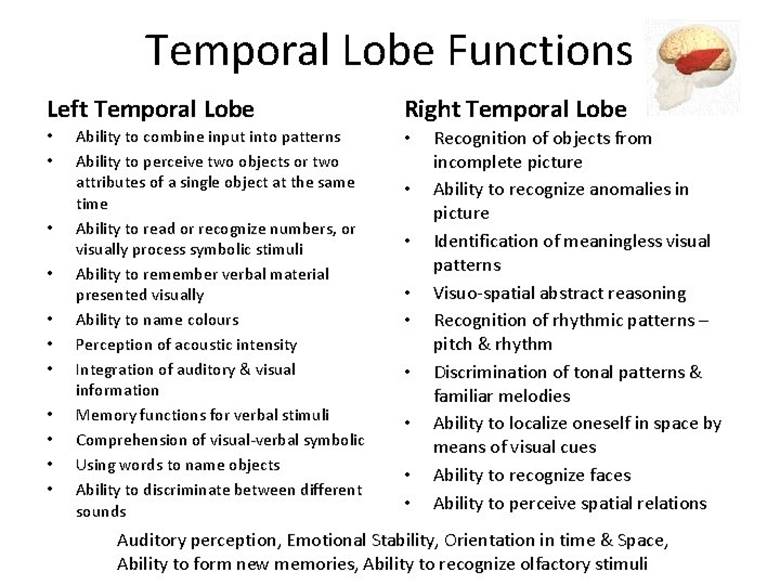
(File credit: SlideToDoc)
The temporal lobe also contains: The amygdala, which manages emotions like fear and anxiety, and plays a part in how you feel when you get a reward and learning-related emotions. The hippocampus is for the brain’s memory storage; it helps with the ability to recognize something (recognition memory) such as objects, sounds or faces, based on stored memories. It stores declarative memories, which are accessible memories you can remember and describe, including memories of events or memorized facts and information. The fusiform gyrus is a critical link between the visual processing center in the occipital lobe and memory storage in the temporal lobe. This structure rapidly analyzes things you see and compares them to stored memories. If it can (either partially or exactly) match what you see with something from your memory, it links the memory to what you’re seeing now so you can recognize it. It’s a key area in recognizing familiar faces.
(Cleveland Clinic)
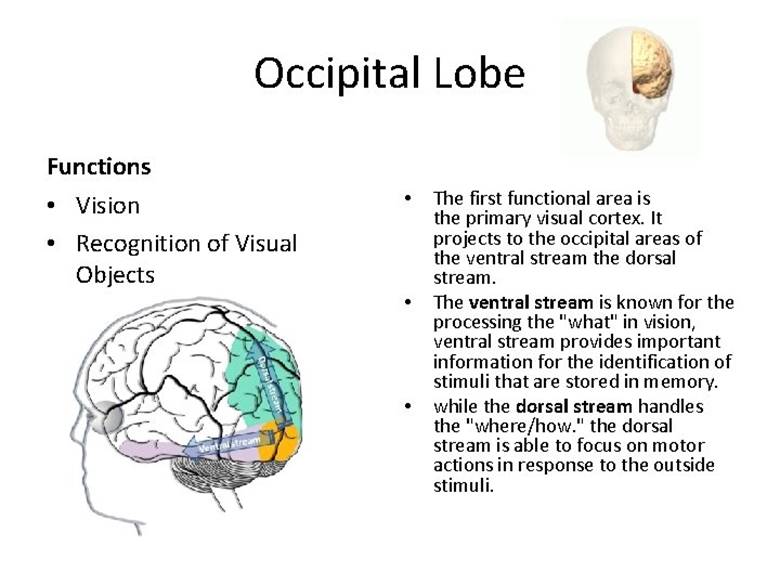
(File credit: SlideToDoc)
It saddened me to make such definitive connections between dementia and impact on the brain because it forced me to “see” that my own mother didn’t stand a chance. She had TIA, likely for years before it was noticeable—and by the time she was diagnosed with dementia she was already in the moderate stage of its impact. Nine months after her diagnosis she had a stroke. It is painful for me to understand how my mother’s situation was a whole brain affair. I look at the information and say to myself, She didn’t have a chance. With TIA, that’s only partly true. She would have had a better chance if the TIA had been addressed in the nine months before her stroke, and of course her chances of stabilizing would have been even greater had the TIA been addressed years earlier.
Looking at the graphics and noting which of the four major dementia conditions impact which parts of the brain, it’s easy to understand why there are so many relatable circumstances for those caring for someone who is journeying through dementia. But even within community, even though the thru lines connect caregivers to one another’s experiences, there is also the isolation of the unique experience. No journey is exactly like another. And no one can save a caregiver from the pain they feel over the living loss they are experiencing. No one can rescue them from the ambiguity of it. It’s an existential crisis, and my experience is there is simply nothing that compares to it. So, dementia caregivers and care partners have to learn how to care for themselves when it seems nearly impossible to do so because the demands of caregiving intensify as the dementia and brain degeneration progress. And there are other stresses. Many caregivers are faced with difficult financial situations. Others aren’t in control of their loved one’s finances and are beholden to often frustrating constraints over items of basic needs and getting the money in place to pay for them. Still others simply don’t get along with family members and family dynamics cause additional, unnecessary stress. Cortisol levels go up and with adrenaline becomes the body’s hormonal overload and there it is: A caregiver is dealing with extremes of varying degrees and through a variety of sources. How to cope? How not to lose a healthy immune system, how not to have blood pressure increase or drop to a dangerous level? How to get enough healing sleep? How not to collapse?
Somewhere in the middle of all my troubles coping with entirely unnecessary constraints at the hands of an obstinate family member who had sole power over my mother’s assets, I did five things, the first four of which were:
- I hired a lawyer.
- I started attending a support group for dementia caregivers (the same I now co-facilitate).
- I contacted the Social Worker in the County where my mother’s facility was located and
- I contacted the Ombudsman for that facility.
Social workers will reach out to the person holding Power of Attorney and/or Medical Agency to assist with any needs a loved one has that aren’t being met (clothing, medication, toiletries, etc.). The Ombudsman is a neutral person who works as an independent state agent serving people needing or receiving long-term care through complaint investigation, advocacy, and education. To find an ombudsman in your area of the United States, key the word into your search engine, along with your state, and look for your Long-Term Care Ombudsman in the county where your loved one resides if they are in a facility. A Social Worker can help whether your loved one is at home or in a facility.
In my case, both the Social Worker and Ombudsman were incredibly helpful. They absolutely were effective in getting resolved impediments to my mother’s needs, and they paved the way for open communication between myself and a wonderful Administrator who set up monthly meetings with me to discuss any concerns I had regarding my mother’s condition or care. I had worked hard to form good relationships with Facility Staff who could help me. My success resulted in the Administrator also giving me her personal cell phone number should I ever have needed to call her directly. And I did. Twice. I cannot emphasize enough how helpful it can be to create a steady foundation of allies to help you care for your loved one. I learned early on how to effectively bypass those who were invested in creating impediments to my involvement in my mother’s care and to find the people who could help me resolve entirely unnecessary problems. It is much more effective and productive to spend your energy finding those who can and are willing to help you than it is to waste your energy fighting with people who have little or no intention to do so. Which brings me to bullet five.
- The last thing I did to help myself with the strain of caregiving was to buy Thich Nhat Hanh's book, No Death, No Fear.
This little book saved my brain from an overload of cortisol, adrenaline, and god-only-knows what other nervous system disruptions occurring in my body as I navigated the many challenges and emotions I faced while helping my mother journey through to her final transition. There is a very simple method in Hanh’s book that helps to calm the mind and reset the nervous system. You can do this anywhere. When I was in a state of crisis after crisis, exhausted, scared, angry, and full of grief (often all at once!), I learned the true value of stopping and drawing on this simple mantra:
I have arrived. I am home in the here and now.
Saying this silently to myself, I would take a deep diaphragmatic breath, a belly breath, confirming, “I have arrived,” and then, letting my breath out slowly , I would say, “I am home in the here and now.” Try it. Put your hand over your navel and breathe in deeply, feeling not your lungs, but your belly rise as you say, I have arrived. Let it out slowly, saying, I am home in the here and now. How many seconds did that take? This is why this is such a wonderful mantra. You do not have to be in a meditative state or sitting on your cushion. You can be stuck in traffic on the freeway. You can be in the emergency room with your loved one. You can be at a group meeting with family members who’ve made trouble for you. You breathe in. No one even notices. You breathe out. It’s your little secret. You relax. You are free to be available to the present moment.
It is difficult navigating the many challenges we face while caring for a loved one with dementia. Looking at what happens to the brain, it’s easy to understand why the one we love struggles in the beginning, and how the brain fails, in the end. The one terrible truth we know from the start is that our loved one journeying through dementia is not going to survive. That is the heartbreaking truth we know immediately upon diagnosis.
As you travel through the ups and downs, the frustrations, joys and sorrows, I hope this illustrative analysis and little exercise of breath and thought will help you get through it; help you calm the rough edges of your experience and help you to know you are nevertheless home in the here and now, and you are not alone.